INDIA MARCH FOR SCIENCE – 2026
India March for Science 2026
An Appeal
An Appeal
Even as science and technology continue to advance at an unprecedented pace, science itself is under growing attack worldwide. The development of science in India is facing growing challenges from the promotion of unscientific ideas and superstition. Public trust in science is eroding, and vital research is being undermined by shrinking funding and the diversion of scientific resources to questionable pursuits such as Panchgavya. Most alarmingly, governments are increasingly ignoring scientific evidence—especially on environmental issues—placing both the planet and humanity’s future at grave risk.
In 2017, more than a million scientists, educators, and supporters of science marched in nearly 600 cities worldwide to defend the role of science in society. Since then, the India March for Science has been organised in cities across the country to raise concern over declining public investment in education and scientific research, evidence-denying policies, and the official promotion of unscientific ideas.
Global warming and climate change are no longer distant threats but an unfolding reality. Extreme weather events, melting glaciers, rising sea levels, collapsing ecosystems, and accelerating species extinction testify to the severity of the crisis. Yet meaningful action remains elusive despite countless summits and declarations. Governments continue to place short-term economic and corporate interests above the urgent need to protect the environment.
India is witnessing widespread deforestation, alarming groundwater depletion, and relentless pollution of rivers and other water bodies. Vast stretches of forests, including those in Chhattisgarh and the Nicobar Islands, are being handed over to corporate interests in the name of ‘development’, while environmental and forest protection laws are steadily being diluted. This reckless exploitation of natural resources is reflected in India’s dismal ranking of 176th among 180 countries in the Environmental Performance Index 2024.
India’s rich scientific heritage is a legitimate source of pride and inspiration. However, presenting unverified and unscientific claims as science distorts that legacy and promotes chauvinism rather than genuine patriotism. More worryingly, such ideas are now being institutionalised through textbooks introduced under the banner of “Indian Knowledge Systems” as part of the National Education Policy (NEP) 2020.
In 2023, NCERT removed several important topics from school textbooks, including Darwin’s theory of evolution, Mendeleev’s periodic table, the history of the Mughal period, and chapters on democracy and human rights. Despite widespread protests from the academic community, these essential subjects have yet to be restored.
Even today, superstition continues to enable the exploitation of vulnerable people through practices such as witch-hunting, human sacrifice, fraudulent faith healing, and oracles. We pay tribute to Dr Narendra Dabholkar, who dedicated his life to securing an Anti-Black-Magic Act. Enacting and implementing such legislation nationwide is an urgent necessity. The Central and State governments must take responsibility for fostering a scientific temper and critical thinking among the people, as per Article 51A(h) of the Indian Constitution.
India has long underinvested in education and research. Many government schools lack even basic science laboratories, while universities face severe shortages of infrastructure, faculty, and support staff. Although every National Education Policy since 1968 has promised to allocate at least 6% of GDP to education, actual public expenditure has consistently remained below 3%. Experts estimate that fulfilling this commitment would require allocating at least 10% of the Union Budget and 30% of State Budgets to education.
Since the introduction of NEP 2020, the education budget has declined further, with only 2.6% of the Union Budget allocated to education in 2026. At the same time, funding for “Indian Knowledge Systems” has increased fivefold, reflecting a disturbing shift away from scientific and secular education.
In recent years, repeated question paper leaks and the student movements that have followed have exposed rampant corruption and serious irregularities in our public examination system. Such failures undermine students’ trust and jeopardize their future. There is an urgent need to scrap the National Testing Agency (NTA), to comprehensively overhaul the public examination system, ensure transparency at every stage, and establish clear mechanisms of accountability for those responsible.
The Gross Expenditure on Research and Development (GERD) as a percentage of GDP, remains below 0.7% of GDP in India, compared with 2.8–3.5% in most scientifically advanced countries. As a result, universities and research institutions face severe financial constraints, fellowship opportunities remain grossly inadequate, and research scholars often experience long delays in receiving their stipends.
At a time of climate crisis, growing obscurantism, and declining support for education and research, we call upon scientists, educators, students, and all science-loving citizens to join the India March for Science and defend science, reason, and our collective future.
Defend Science, Defend the Future!
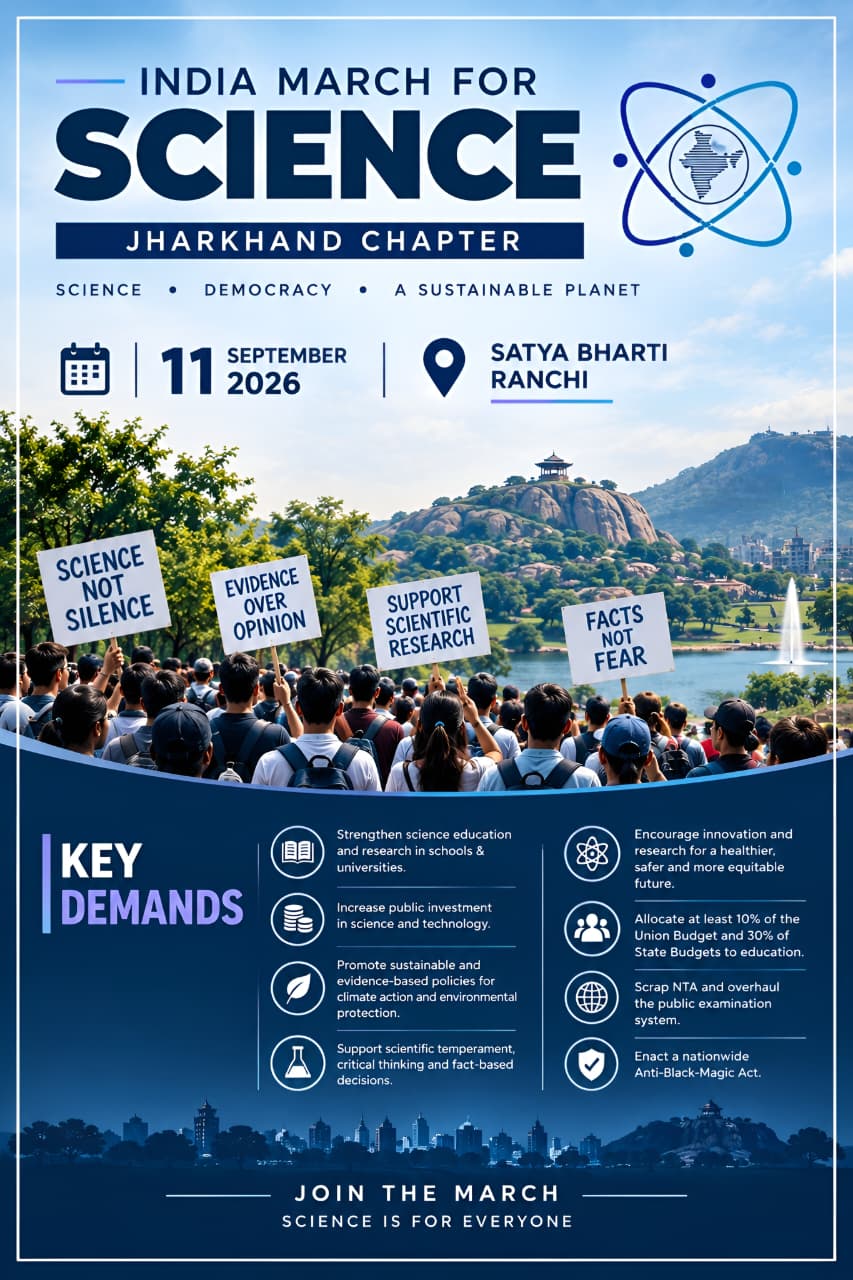
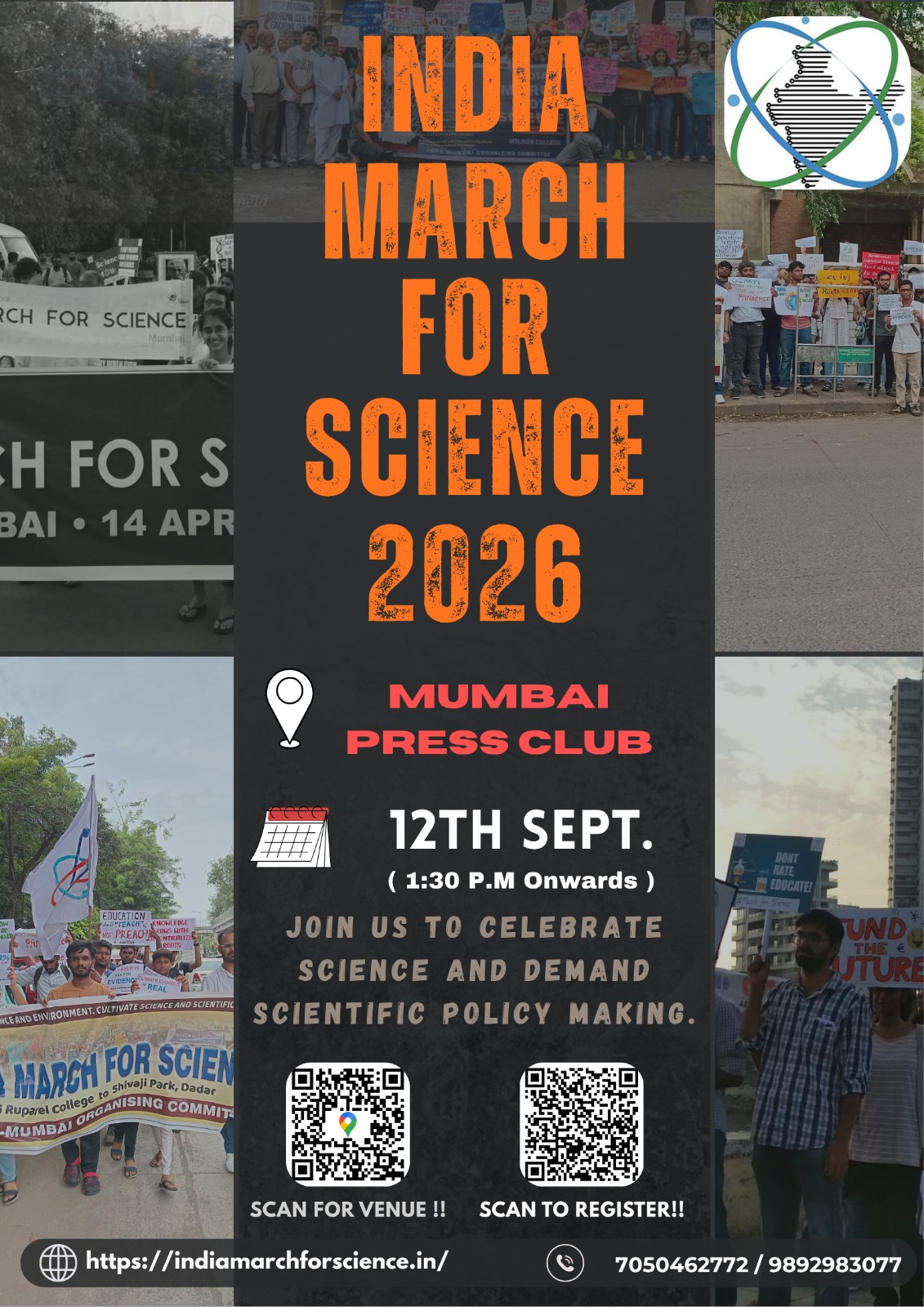
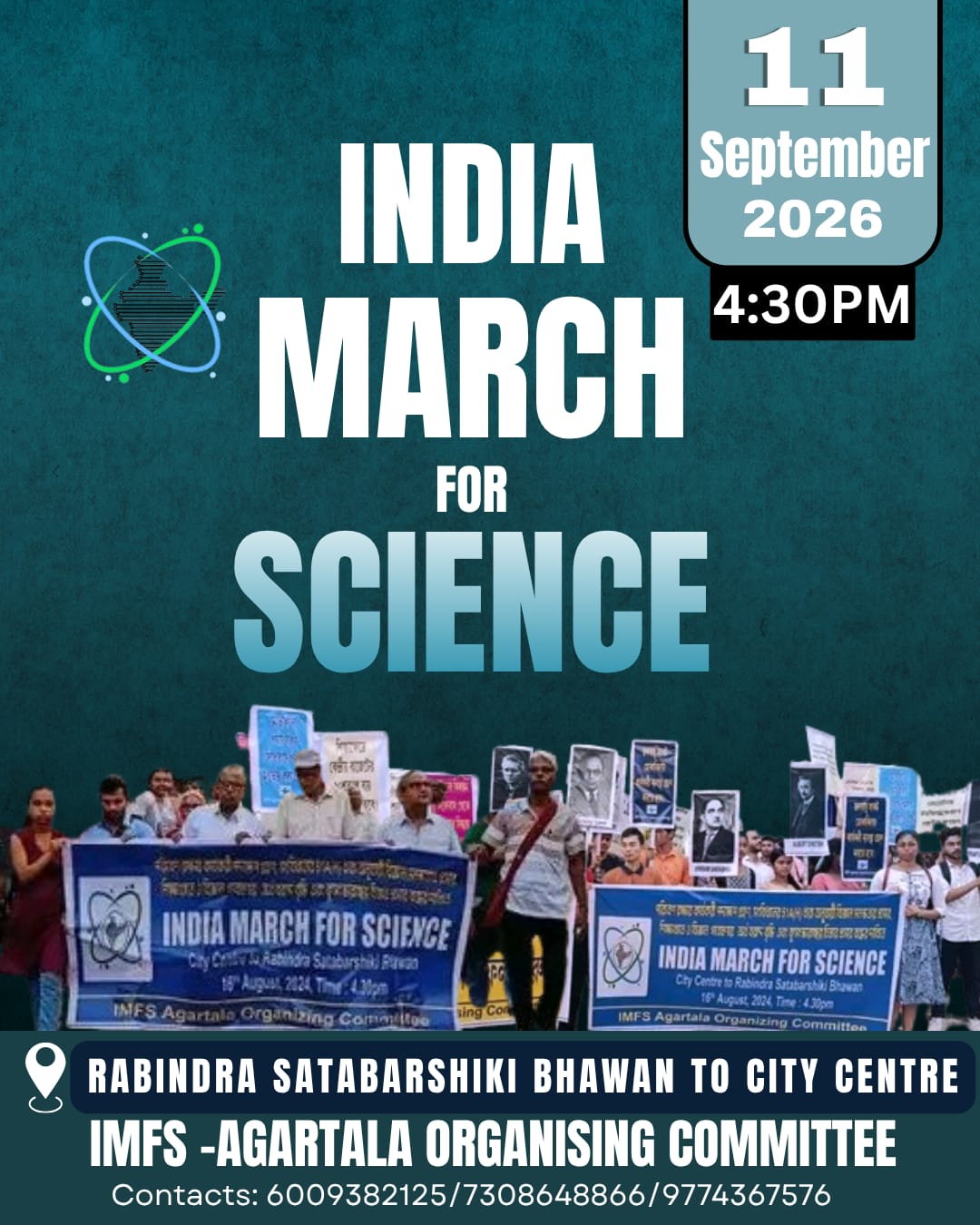
Join the India March for Science in your city on 11/12 September to demand:
- Adopt urgent, evidence-based policies to address the climate crisis, and implement stringent forest protection laws to halt environmental destruction. Stop the destruction of forests in Odisha, Chhattisgarh, Madhya Pradesh, the Aravalis, the Nicobar Islands and other places in the name of development.
- Stop using public money in the promotion of superstition, pseudoscience, and obscurantist ideas. Stop the inclusion of unscientific content in educational curricula in the name of IKS.
- Scrap the NTA, comprehensively overhaul the public examination system, to ensure transparency and accountability.
- Improve the standard of government schools, colleges and universities. Allocate at least 10% of the Union Budget and 30% of State Budgets to education, and substantially reduce fees at all levels of public education.
- Increase investment in scientific, technological, and social science research to at least 3% of GDP to strengthen India’s research and innovation capacity.
- Enact a nationwide Anti-Black-Magic Anti-Superstition Act to eliminate inhuman, exploitative, and superstitious practices.
Appeal by:
(Opinions held by the signatories are their own and do not necessarily reflect those of their Institutes.)
- Prof S G Dani, former Professor, TIFR and former President of the National Board for Higher Mathematics
- Prof. Dhrubajyoti Mukherjee, INSA fellow, former HOD of Geology, CU and President, Breakthrough Science Society
- Prof. Chandrashekhar Chakraborty, Ex-VC, West Bengal University of Animal and Fishery Sciences
- Prof C P Rajendran, National Institute of Advanced Studies, Bengaluru
- Prof Amitava Datta, Retd. Prof. of JU and IISER-Kolkata President, IMFS Kolkata Organizing Committee
- Prof. Purnendu Kanti Das (Prominent Science Writer, former President of Tripura Chemical Society)
- Prof.Mihir Deb (former Chairman of TSPCB, former President of TBSE)
- Prof. Brij Mohan Arora, former Professor, IIT Mumbai
- Prof. Aniket Sule, HBCSE -TIFR, President of IOAA
- Prof.Jyotiprakash Roy Chowdhury (Retd.Professor,MBB College and Prominent Science Activist)
- Prof.Priyasankar Chowdhury (Retd.Prof,Dept of Zoology, Tripura University & Advisor, BSS-Tripura Chapter)
- Prof. Anirban Pathak (FNAsc), physicist, JIIT, Noida.
- Prof. M S Raghunathan, Padma Bhushan, FRS, former Head of the National Centre for Mathematics and IIT Mumbai
- Prof. Soumitro Banerjee, S S Bhatnagar awardee, IISER-Kolkata, General Secretary, Breakthrough Science Society.
- Dr. Amitabh Basu, retd scientist, CSIR-NPL, New Delhi
- Dr. Chetna Sachidanand, scientist, CSIR-IGIB, New Delhi
- Prof C P Aravindakshan, Science activist and science writer, President, Breakthrough Science Society, Kerala Chapter
- Prof Kurien Issac, former Professor, IIT Bombay and IIST Thiruvananthapuram
- Prof. Amitabh Bose, Former Proctor, Kolhan University, Chaibasa, Jharkhand
- Prof. Ashok Prasun Chattopadhyay, former professor, Kalyani University
- Prof. Ayan Banerjee, IISER Kolkata
- Prof. Anindita Bhadra, IISER Kolkata
- Prof. Siddhartha Sen, Former Professor, IIT Kgp
- Prof. Ansuman Lahiri, Department of Molecular Biology & Genetics, CU
- Prof. Kiran Shukla, former HoD, Botany, Kolhan University
India March for Science 2026: Events



IMFS MOVEMENT
India March for Science is an integral part of the global March for Science
Science and scientific temper are the pillars on which the material development, prosperity, and cultural well-being of the Indian people rest.
‘India March for Science’, as an integral part of the global March for Science is an earnest endeavor to celebrate science to underscore the importance of cultivating scientific temper, and also to resist the attempts to propagate superstitious beliefs.
Contact Us
Please fill in the form. We will contact you soon.
8A Creek Lane
Calcutta – 700014
9433369069, 9433944608
contact@indiamarchforscience.in